As an Amazon Associate I earn from qualifying purchases.
Matching pajamas look simple, and then the first set arrives. Hers fits like a glove and yours fits like a tent, the adorable print fades by the third wash, and the Christmas-morning photo shows two people in pajamas that only match in theory. Sleepwear is the most technical matching outfit you will ever buy, because it has to satisfy fabric rules, safety rules, and two very different bodies at the same time. This guide works through fabrics, sizing, and care in that order, so the set you buy is the set that still matches in the photo, and still fits at bedtime.
Mother Daughter Outfits
Matching Looks, Day and Night
Pair these pajamas with the holiday outfits guide for the full Christmas-morning picture, presents to portraits.
Key Takeaways
- Choose the fabric for the season and the sleeper first, because the wrong fabric ruins more nights than the wrong print ever will.
- Size the child’s set by the snug-fit safety standard and the adult set by comfort, because the two halves of a matching set follow different rules.
- Keep one photo set for Christmas morning and cheaper, softer sets for every night, so the special set stays special.
- Wash prints inside out in cold water from the first wash, because care in week one decides how the set looks in year two.
- Measure your daughter before every order, because kids’ pajama sizing runs by height and weight, not by the age on the label.
Table of Contents
- Start With Sleep, Not the Print
- Fabrics Decoded for Real Bedrooms
- Sizing Across Adult and Kids, and Why Hers Fits Snug
- Christmas-Morning Sets vs Everyday Sets
- Styles Beyond the Two-Piece Set
- Three Sets That Get It Right
- Care That Keeps a Set Matching
- Pajamas for Tweens and Teens, Where the Snug Rules End
- Matching Pajamas as Gifts
- Our view
- FAQ
Start With Sleep, Not the Print
Every pajama purchase starts with the print, because the print is what the photograph needs. But the photograph lasts ten minutes, and the pajamas have to perform for eight hours a night, in a bedroom whose temperature nobody fully controls, on a child whose sleep is still building her brain. The CDC sleep guidance for children and adolescents puts the need plainly: school-age children need nine to twelve hours of sleep, and teenagers need eight to ten. Sleepwear that runs hot, itches, or twists is not a small flaw in that picture. It is a nightly tax on the hours she is supposed to be getting.
The two jobs of a matching set
A matching set has two jobs that pull in opposite directions. The photo job wants a bold print, a saturated color, and a fabric that holds its shape under a camera flash. The sleep job wants breathability, softness, and a fit that disappears. The archived CDC school sleep research ties insufficient sleep in students to real daytime costs, which is a long way of saying the sleep job wins every tie. Buy for the night first, then choose the prettiest option among the sets that sleep well, and the photo will take care of itself, because a rested daughter smiles better than a styled one.
The comparison below shows how the same set can pass one job and fail the other, and where the smart compromise sits.
| Feature | Photo-first choice | Sleep-first choice |
|---|---|---|
| Fabric | Stiff polyester that holds a print | Cotton or bamboo that breathes through the night |
| Fit | Roomy and flowing for both | Snug for her by safety design, relaxed for you |
| The boldest pattern in the range | A print you both still like at wash twenty | |
| Quantity | One perfect set | One photo set plus everyday sets in rotation |
Notice that the sleep-first column never asks you to give up matching. It asks you to match on a foundation that works at 2 a.m., which is when pajamas earn their keep. The rest of this guide is that column, expanded. And if the photo is the Christmas one, our holiday matching outfits guide covers the dressed-up half of the day that follows it.
Fabrics Decoded for Real Bedrooms
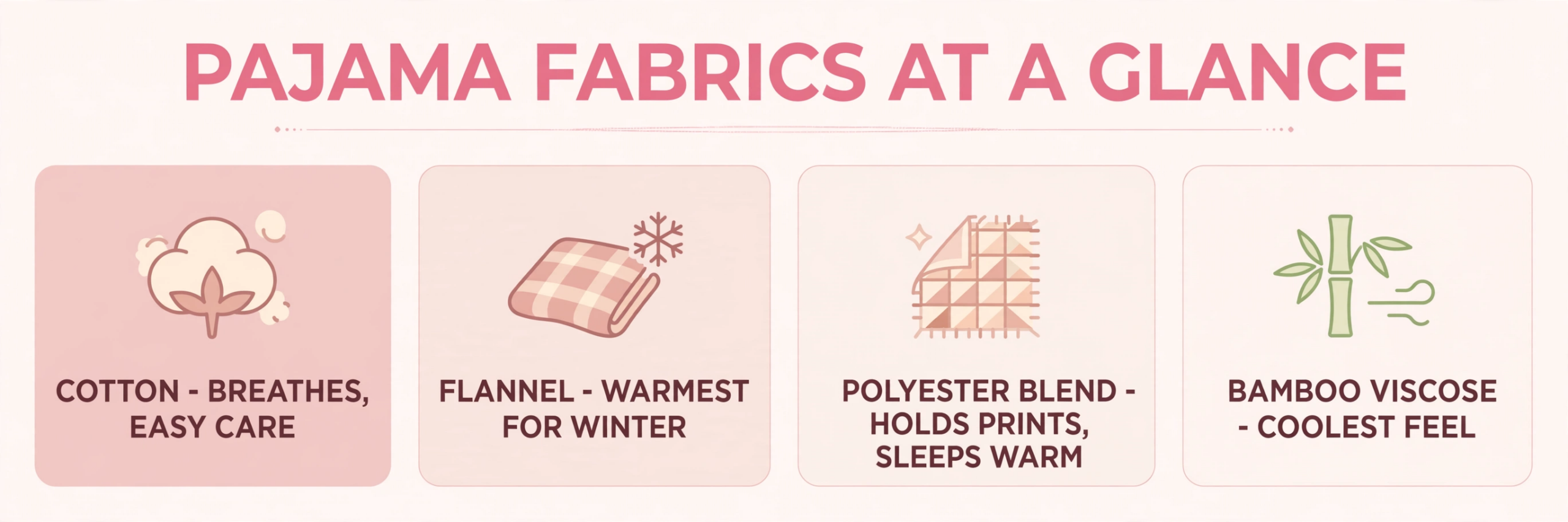
Four fabrics cover nearly every matching set you will meet, and each one has a season, a sleeper, and a failure mode. Cotton is the default for a reason: it breathes, it washes without ceremony, and it suits most bedrooms most of the year. Flannel is cotton’s winter form, brushed for warmth, and it is the fabric of the classic Christmas plaid. Polyester and its blends hold prints the best and dry the fastest, but they sleep warm, which is a feature in January and a flaw in July. Bamboo viscose is the cool, silky option for hot sleepers and warm climates, at a higher price and with gentler washing needs.
Match the fabric to the sleeper, not the season alone
The fabric advice in what to wear to bed for better sleep runs along the same lines: natural, breathable fabrics help the body regulate temperature through the night, and loose, non-restrictive fits support uninterrupted sleep for adults. The hot-sleeper guidance in the best pajamas for night sweats adds moisture handling to the checklist, because a fabric that breathes but holds sweat still sleeps damp. For a mother who runs warm sharing a matching set with a daughter who runs cold, the honest answer is two fabrics in one print family where the brand allows it, or a midweight cotton that splits the difference.
The fiber-by-fiber comparison at best fabrics for sleepwear and the cooling-focused notes in the best material for pajamas to keep you cool both land where experienced buyers land: there is no best fabric, only the best fabric for a body, a bedroom, and a season. The roundup at best clothes to sleep in makes the comfort point from the luxury end, where softness is the whole product. Read those three together and the shopping rule writes itself: decide who sleeps hottest in your house, buy her fabric first, and let the print follow.
Sizing Across Adult and Kids, and Why Hers Fits Snug
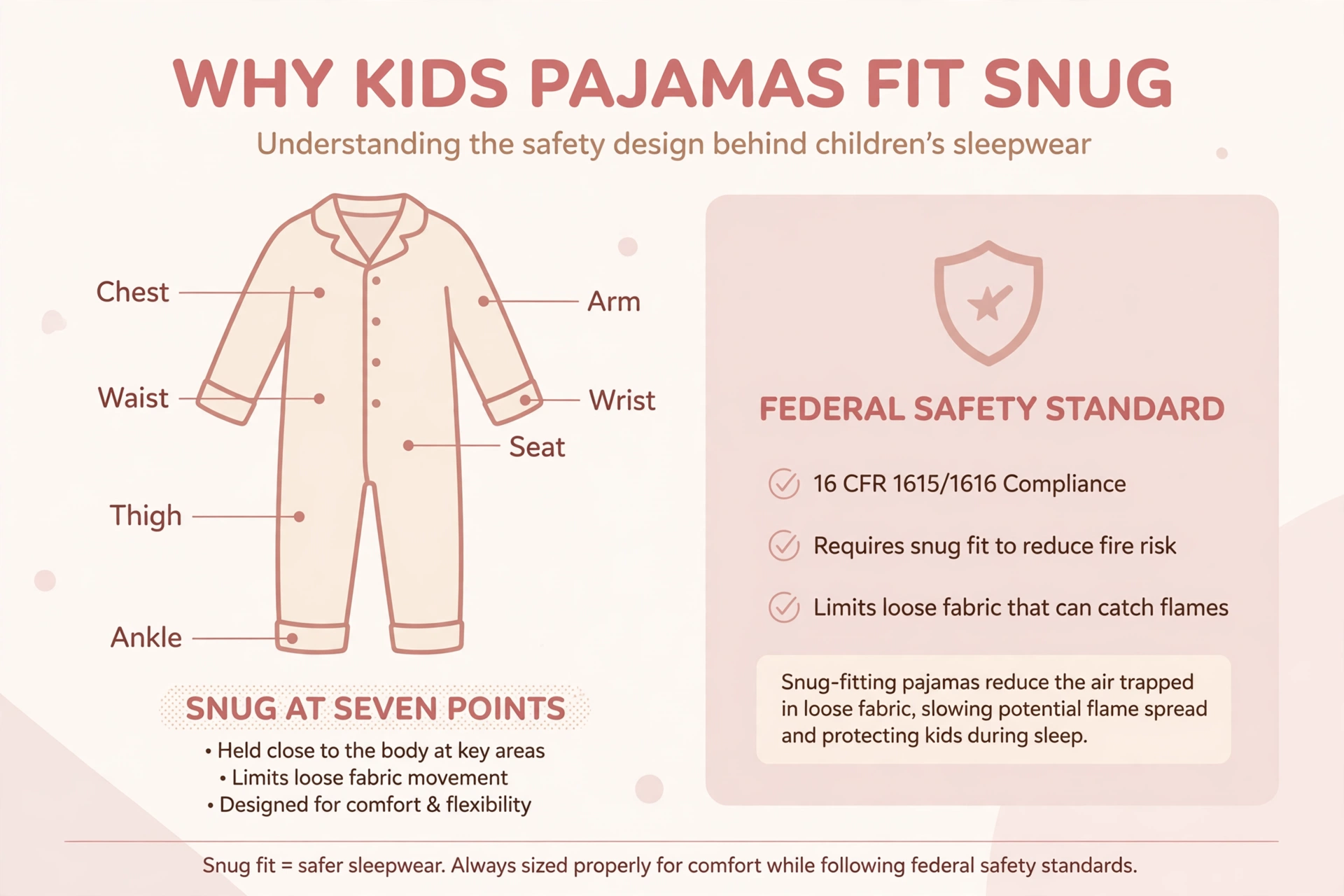
The strangest moment in matching-pajama shopping is discovering that her set is supposed to fit like a wetsuit while yours hangs loose. That is not a sizing error. It is federal safety design. Under the children’s sleepwear standards in 16 CFR Parts 1615 and 1616, children’s sleepwear above nine months and up to size fourteen must either be flame resistant or fit snugly, because loose fabric catches fire more easily and burns faster. The CPSC sleepwear amendment background explains the burn-injury research behind the rule, and the GAO review of the amendment documents how the snug-fit exemption works in practice: maximum measurements at the chest, waist, seat, arm, thigh, wrist, and ankle.
What snug-fit means for your order
Three practical consequences follow. First, never size up a child’s pajamas to grow into, the way you might a coat. A sized-up snug-fit set is a loose set, which defeats the safety design and usually trips her on the pant legs besides. Second, measure her and use the brand’s height-and-weight chart, because kids’ pajama sizes track body measurements far more closely than the age printed on the tag. The sizing walkthrough in family Christmas pajamas sizing guidance shows a real brand’s chart working exactly this way, with the mother’s size chosen from a completely separate adult chart. Third, expect the adult half of the set to follow ordinary adult sleepwear rules, which the parent’s guide to safe sleep context complements for the youngest wearers: comfort, breathability, and nothing restrictive.
For the borderline ages, the onesie and footed styles have their own fit logic, looser in the body because they are worn as a single piece, and the children’s sleepwear fact sheet is the document to check before assuming any style is exempt. When in doubt, the hangtag tells you: snug-fit sets carry a yellow tag saying they are not flame resistant and should fit snugly. That tag is your friend. It means the set was designed under the standard, not around it.
Christmas-Morning Sets vs Everyday Sets
The set in the Christmas photo and the set she sleeps in three nights a week should not be the same purchase, even when they are the same print. A photo set is bought for one morning: the richest print, the classic button-down silhouette, the fabric that reads as festive under flash. An everyday set is bought for fifty nights: the softest hand-feel, the easiest washing, the price that lets you own three in rotation. Families who buy one set to do both jobs end up with a photo set that fades by February and everyday nights spent in the scratchy special-occasion fabric.
Building the two-tier drawer
Keep the tiers honest. The Christmas set gets worn for the morning, the photo, and perhaps a movie night, then it goes back in the drawer while it still looks new. The everyday sets rotate, so no single set takes every wash. This is the same wardrobe logic as our matching wardrobe on a budget guide, applied to the drawer nobody photographs: spend where it shows, save where it repeats. For the mornings themselves, the relaxed end of the wardrobe in our casual weekend style guide picks up where the pajamas come off.
Order timing matters for the photo tier. Matching Christmas sets sell through sizes early, and the sizing guidance in the PATPAT Christmas pajamas guide recommends ordering well ahead and checking each wearer’s measurements against the chart rather than trusting last year’s sizes. A daughter who grew two inches since summer is wearing a different size this Christmas, whatever the drawer at home suggests.
Styles Beyond the Two-Piece Set
The button-down two-piece is the classic, but it is not the only silhouette that matches well, and for some sleepers it is not the best one. Nightgowns suit daughters who tangle in pant legs and mothers who run warm, because air moves under a gown the way it never moves under a waistband. Short sets own the summer, when the fabric rules from earlier in this guide tighten around breathability and a long flannel becomes a punishment. Onesies own the novelty end of the drawer, the sleepover and the holiday movie night, and they solve the top-versus-bottom sizing split by deleting it. Robe-and-pajama combinations own the Christmas morning itself, because the robe is what she actually wears over breakfast, in the photos, and out to the mailbox for the forgotten present run.
Choosing a silhouette for each wearer
The matching does not require the same silhouette on both bodies, and often it should not try. A mother in the button-down and a daughter in the matching-print nightgown read as a set in every photograph, while each sleeps in the cut that suits her. The same principle runs through the bolder end of this site’s wardrobe, where our edgy boutique styles guide coordinates by palette and attitude rather than by identical garment. Sleepwear is simply that principle at its most practical: match the print family, match the fabric tier, and let the silhouette follow the sleeper. The one silhouette rule that does bind both wearers is length on stairs and cold floors. A gown or pant that pools at the ankle is a trip hazard at 2 a.m., whatever the photograph prefers, and hemming a pajama is the cheapest alteration in the wardrobe.
Three Sets That Get It Right
The Ekouaer button-down set below is the Christmas-morning archetype: a classic long-sleeve, button-front silhouette in a festive print, cut in the traditional pajama shape that photographs like the holidays are supposed to look. Buy it as the photo tier, size her half snug by the chart, and let it live most of the year in the drawer.
The Ekouaer hooded onesie set below is the playful tier, built for the Christmas Eve movie, the cousin sleepover photo, and the daughter who finds two-piece sets boring. Onesies photograph as pure fun, they are warm without a blanket negotiation, and they sidestep the top-versus-bottom sizing split entirely. They are also the easiest matching win for a reluctant tween, the same way a bold shared theme carries the festival and concert outfits when one wearer needs convincing.
The Burt’s Bees Baby family set below is the everyday tier done properly: organic cotton, the fabric this guide keeps recommending for real sleep, at a price that allows rotation. This is the set to own in multiples, the one that survives the wash cycle described in the next section, and the one a younger daughter will actually live in. Families building a gift around sleepwear can pair it with the ideas in our bridal shower gift guide for the adult end of the family.
Care That Keeps a Set Matching
A matching set stops matching in the wash long before it wears out. One half fades faster, one half shrinks a size, and the photo shows two cousins of the same pajamas rather than a pair. The defense is boring and total: wash both halves together, every time, in the same load, inside out, in cold water. The care-label rules in the FTC Care Labeling Rule require manufacturers to give instructions that keep the garment in service, which makes the label on your specific set the first authority, ahead of any general advice including this guide’s.
The habits that preserve prints and fit
Cold water slows dye loss. Inside-out washing protects the print’s surface from friction. Skipping the hottest dryer setting protects both the print and the snug fit, because heat is what relaxes elastic and shrinks cotton unevenly between two different-sized garments. The fabric-specific guidance in best fabrics for sleepwear notes bamboo’s need for gentler handling, and the cooling-fabric notes at Banner Mattress make the same point for performance weaves: the fabric that sleeps best often washes gentlest. Treat the Christmas set to the full ceremony and the everyday sets to at least the cold, inside-out basics, and both tiers will still match when the next photo comes around. The rest of the morning-after routine, from cocoa to the couch, belongs to the same slow rhythm as our mother daughter brunch guide, which starts, as all good mornings do, in pajamas.
Pajamas for Tweens and Teens, Where the Snug Rules End
The snug-fit standard has a boundary, and it sits at the top of the children’s size range. The children’s sleepwear fact sheet covers sizes above nine months through size fourteen, which means a tall twelve-year-old may already be shopping in sizes the standard no longer governs, and a teenager certainly is. Once your daughter crosses into adult sizes, her half of the matching set follows the same rules as yours: comfort, breathability, and the sleep needs in the CDC sleep guidance, which asks eight to ten hours for teenagers and rewards every habit that protects them.
The negotiation changes at thirteen
What changes most is not the regulation but the wearer. A tween or teen has opinions about prints that a six-year-old does not, and a matching set she finds babyish will be worn once, for the photo, under protest. The fix is to move the matching up a level: same color family, different cuts, or the same fabric in her silhouette and yours. The style dynamic in our guide to how adult daughters influence moms’ style starts in these years, at the pajama drawer as much as anywhere. Let her choose the print from a shortlist you can both live with, keep her in the softest fabric tier, and save the identical-set photograph for the years when she asks for it herself, which, surprisingly often, she does by about sixteen. The trends in our mother daughter fashion trends guide keep cycling matching back into fashion for exactly this age group, so the drawer you build now will not stay embarrassing for long.
Matching Pajamas as Gifts
A matching pajama set is one of the few gifts that works for nearly every mother-daughter occasion on the calendar: the new baby’s first Christmas, the daughter leaving for college, the grandmother who insists she wants nothing. It photographs at the moment of giving, it gets used the same night, and it carries its meaning without a card having to explain it. The gift works because it is really an invitation: wear these with me, on a morning we choose together.
Giving a set that fits someone you cannot measure
The risk is sizing, and the defense is the size chart plus one question asked casually in advance. If the set is for another family, choose the styles with the most forgiving cuts, the button-down and the onesie, and keep the receipt where the giver can find it. Our bridal shower gift guide treats sleepwear-adjacent gifting for brides and mothers with the same care, and the tattoo-inspired matching styles guide shows how a shared motif can carry the matching when identical sizing is too risky to guess. For your own daughter, none of this caution applies: measure her, chart her, and buy the snug fit the standard intends. A gift set for your own house is also the one purchase where the two-tier rule relaxes, because a gifted Christmas set joins the photo tier the moment it is unwrapped, and the everyday drawer can be restocked in the sales that follow the holiday.
Our view
We think matching pajamas are where this site’s whole philosophy shows up in miniature. The print is the fun, but the fabric, the fit, and the wash are the love. Buy her half snug because the safety standard is smarter than our instincts, buy your half for the sleeper you actually are, keep the Christmas set special by not sleeping it to death, and wash the pair together like a pair. Do that, and the Christmas photo takes itself, this year and every year she still fits in the kids’ chart. — Mother Daughter Outfits
FAQ
Why do kids’ pajamas fit so tight compared to adults’?
Because federal safety standards require it. Under 16 CFR Parts 1615 and 1616, children’s sleepwear must be flame resistant or snug-fitting, since loose fabric ignites more easily. Adult sleepwear carries no such rule, so the two halves of a matching set are designed to different fits on purpose. Never size up her set to make it looser.
What fabric is best for matching pajamas?
Cotton for most families, most of the year: it breathes, washes easily, and suits the CDC sleep duration guidance your daughter’s nights are built around. Flannel for cold winters, polyester blends for the brightest prints and fastest drying, and bamboo viscose for hot sleepers. Match the fabric to the hottest sleeper in the set.
How many matching sets should we own?
Three in rotation for everyday wear, plus one photo set kept special. Rotation is what keeps prints bright and elastic alive, and it follows the same spend-where-it-shows logic as our boutique finds guide. One set, washed twice a week, will fade and sag before the season ends.
When should we order Christmas matching pajamas?
Early, and by measurements, not memory. The PATPAT sizing and ordering guidance recommends checking each wearer against the size chart before ordering, because popular prints sell through sizes fast and children grow between summers. Pair the pajamas with the dressed-up looks in our holiday outfits guide for the full day.
Planning a Trip or a Matching Look?
Start with the guides other moms and daughters actually use — the Texas trips hub, the Europe breaks, and the matching-outfit guides for every age.
Sources
- Children’s Sleepwear Fact Sheet, 16 CFR 1615 and 1616 — U.S. Consumer Product Safety Commission
- CPSC’s Sleepwear Amendment to Help Reduce Burn Injuries to Children — U.S. Consumer Product Safety Commission
- Care Labeling Rule, 16 CFR Part 423 — Federal Trade Commission
- Family Christmas Pajamas: What Size and When to Order — PATPAT
- A Parent’s Guide to Safe Sleep — HealthyChildren.org
- About Sleep — Centers for Disease Control and Prevention
- Students and Sleep — CDC Healthy Schools (archived)
- Review of the Children’s Sleepwear Amendment — U.S. Government Accountability Office
- What to Wear to Bed for Better Sleep — Daily Healthy Body
- Best Pajamas for Night Sweats — Bedfan
- Best Fabrics for Sleepwear — Fibr
- Best Material for Pajamas to Keep You Cool — Banner Mattress
- Best Clothes to Sleep In for Better Sleep — Softies