As an Amazon Associate I earn from qualifying purchases.
Matching swimsuits fail in a particular way. The print matches perfectly in the product photo, and then she refuses the scratchy lining, your top needs constant adjusting, and the cover-up you packed works for lunch but not for the walk back through the lobby. Swim is the most physical matching outfit you will buy, because it has to move, get wet, dry, and protect two different bodies at once. This guide works through cuts, coverage, sun protection, and care in that order, so the suits you pack are the suits you both actually swim in.
Mother Daughter Outfits
Match in the Water, Not Just the Photo
Start with the Texas trips hub for where to go, then use this guide for what to wear once you get in the water.
Key Takeaways
- Match on print or color family, not on identical cut, because an adult body and a child body need different support, straps, and coverage.
- Put sun protection first with UPF fabric, shade, and sunscreen on uncovered skin, because a swimsuit covers only the skin underneath it.
- Choose her suit for movement and bathroom breaks and yours for support and staying power, because a suit that shifts ends the swim early.
- Pack the resort layer with the suit, a cover-up, a hat, and sandals that survive water, because the walk to and from the pool is half the outfit.
- Rinse in fresh water and dry in shade after every swim, because chlorine, salt, and heat are what fade a matching set unevenly.
Table of Contents
- Start With the Swim, Not the Print
- Cuts That Work on an Adult and a Child
- Coverage Is a Preference, Not a Problem
- Sun Protection Built Into the Suit
- Matching Without Identical Suits
- Three Sets That Get It Right
- Resort Wear, the Other Half of the Outfit
- Sizing, Fit Checks, and Bathroom Breaks
- Water Safety Shapes the Wardrobe
- Care That Keeps Two Suits Matching
- Our view
- FAQ
Start With the Swim, Not the Print
Every matching-swimsuit purchase starts with the print, because the print is what the vacation photo needs. But the photo lasts ten minutes, and the suit has to perform for hours in water that pulls at straps, loosens elastic, and turns a marginal fit into a constant adjustment. The pool guidance in the CDC healthy swimming pages is a useful reminder of what a swim day actually involves: showering before entering, bathroom breaks and diaper checks every hour, and close supervision the whole time. A suit that is hard to get off a wet child, or that needs two hands to reset after every slide, fights every one of those routines.
The two jobs of a matching suit
A matching suit has two jobs that pull in opposite directions. The photo job wants the same print, the same silhouette, and a saturated color that reads well in bright sun. The swim job wants straps that stay, a lining that does not itch, and a cut each wearer can move, bend, and climb pool steps in. Buy for the swim first, then choose the prettiest option among the suits that swim well, and the photo will take care of itself, because a comfortable daughter plays better on camera than a styled one. This is the same planning split as our Texas trips hub, which owns where to go, while this guide owns what to wear in the water.
The comparison below shows how the same set can pass one job and fail the other, and where the smart compromise sits.
| Feature | Photo-first choice | Swim-first choice |
|---|---|---|
| Cut | Identical silhouette on both bodies | Same print, cut fitted to each body |
| Straps | Thin decorative straps | Wide or adjustable straps that stay in the water |
| The boldest pattern in the range | A print you both still like after a week of swims | |
| Quantity | One perfect set | Two sets in rotation so one is always dry |
Notice that the swim-first column never asks you to give up matching. It asks you to match on a foundation that works at the deep end, which is where swimsuits earn their keep. Families planning the trip itself can pair this guide with our mother daughter trips in the USA guide for the destination half of the decision.
Cuts That Work on an Adult and a Child
Four cuts cover nearly every matching set you will meet, and each one solves a different problem. The one-piece is the workhorse: it stays in place through slides and cannonballs, it gives a child nothing to retie, and it gives a mother support options, from shelf bras to molded cups, that a string top never will. The tankini is the practical two-piece, with a top long enough to meet the bottom, easier bathroom breaks than a one-piece, and coverage that can differ between the two wearers while the print stays the same. The high-waisted two-piece suits a mother who wants a two-piece with more midsection coverage and a daughter in the matching-print one-piece or tankini, which is matching by print rather than by silhouette. The long-sleeve rash guard suit is the sun and surf option, built for long beach days, boogie boards, and daughters who burn before they tan.
Match the cut to the swimmer, not the set
The mistake to avoid is forcing one silhouette onto both bodies because the listing photographs it that way. A cut that flatters an adult, a low neckline or a cut-out side, has no child equivalent that makes sense, and a cut built for a child, ruffles and bows, can feel costume-like on her mother. The better rule is the one our photo shoot outfits guide uses for cameras generally: coordinate the palette and the print family, then let each wearer take the version of the look that suits her. In swim, that means your one-piece with support and her one-piece with a higher neckline and wider straps can be the same set in every photograph, while each swims in the cut that suits her. For active water, prioritize straps that cross or anchor at the back, leg openings that do not ride, and a lining smooth enough that a child stops noticing it within a minute of putting the suit on.
Coverage Is a Preference, Not a Problem
Coverage is where matching sets get needlessly difficult, because mothers and daughters often want different amounts of it, and both preferences are legitimate. A mother may want a higher leg line and a lower neckline, or the reverse. A daughter may want the sporty rash guard her surf lesson requires, or may be at the age where she has firm opinions about straps and ruffles. Neither preference needs to win for the set to match. Print, color, and fabric carry the matching. Coverage can be negotiated wearer by wearer, the same way our casual weekend style guide coordinates by palette rather than by identical garment.
Coverage tools that keep the match
Three tools make different coverage read as one outfit. First, the shared print in different cuts, covered above, is the strongest signal in any photo. Second, a shared cover-up, the same sarong print or the same white shirt dress over different suits, unifies the walk to the pool even when the suits underneath differ. Third, matching accessories, hats, sandals, or a tote in the print, carry the theme for a wearer whose suit is a plain coordinating solid. A tween or teen daughter who will not wear the identical suit will often happily wear the solid in the family color with the matching hat, which is the same negotiation our matching pajamas guide recommends at the age where identical sets start to need consent. Let the matching live at the level each wearer accepts, and the vacation keeps both the photo and the peace.
Sun Protection Built Into the Suit
A swimsuit is also sun equipment, and this is the section where fabric numbers matter more than prints. The dermatologists at the American Academy of Dermatology explain in what to wear to protect your skin that dense fabrics and dark or bright colors protect better, and that dry clothing protects more than wet clothing. The Skin Cancer Foundation makes the same point in its guide to sun protective clothing: clothing is one of the most effective forms of protection, and coverage is part of the rating, because a fabric can only protect the skin it covers.
Reading UPF like a label, not a slogan
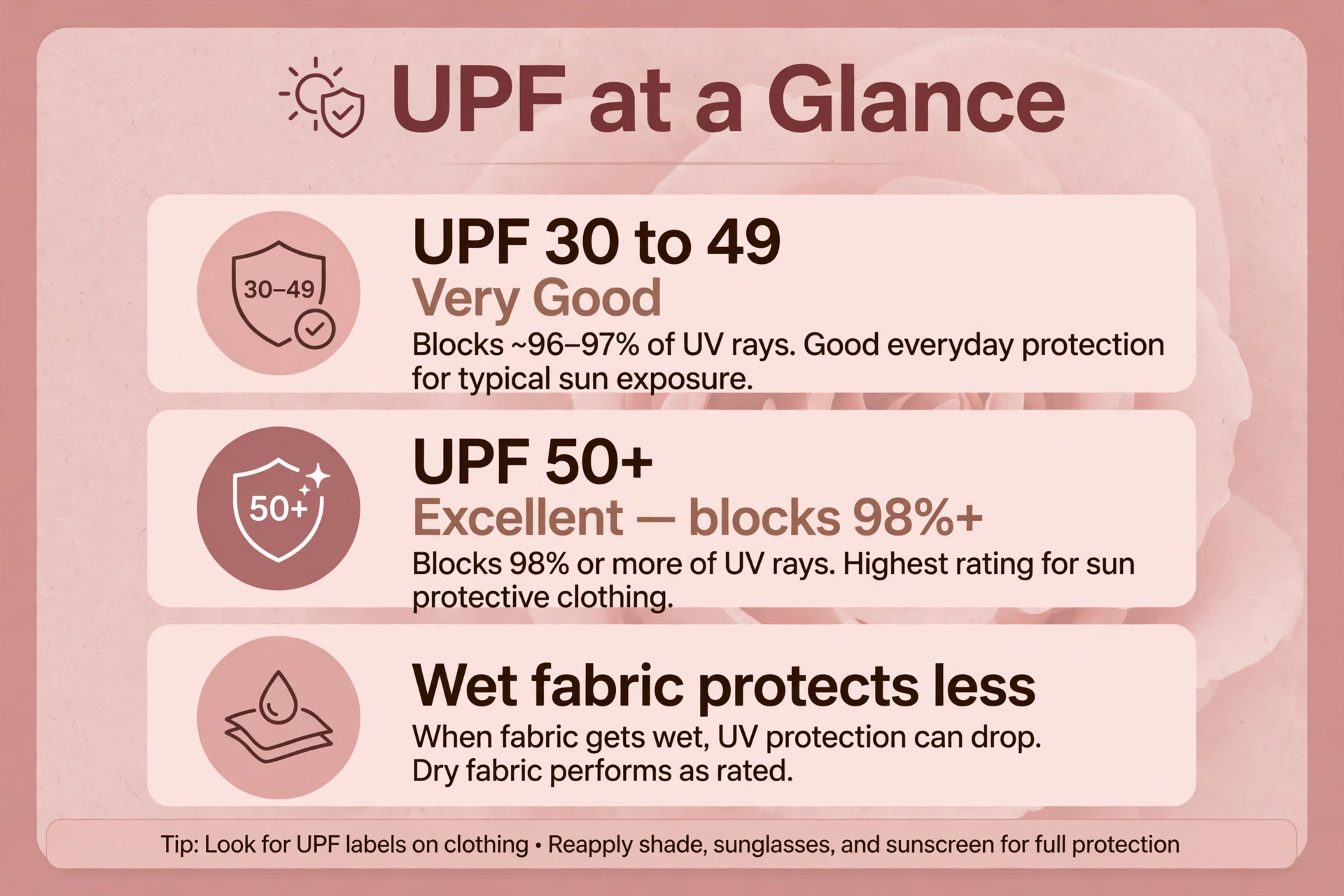
UPF, ultraviolet protection factor, measures how much UV radiation a fabric allows through. The Foundation’s expert answers on sun protection put the scale plainly: UPF 30 to 49 offers very good protection, UPF 50 and above offers excellent protection, and its Seal of Recommendation for fabrics requires a minimum UPF of 50, which blocks most of the sun’s rays and allows only a small fraction to penetrate. Its separate guide to sunscreen completes the picture: sunscreen belongs on every area clothing does not cover, reapplied as directed, because no suit covers a face, ears, or the backs of hands. The AAD’s sunscreen FAQs give the matching sunscreen rules, broad spectrum, water resistant, and SPF 30 or higher, applied to all skin not covered by clothing.
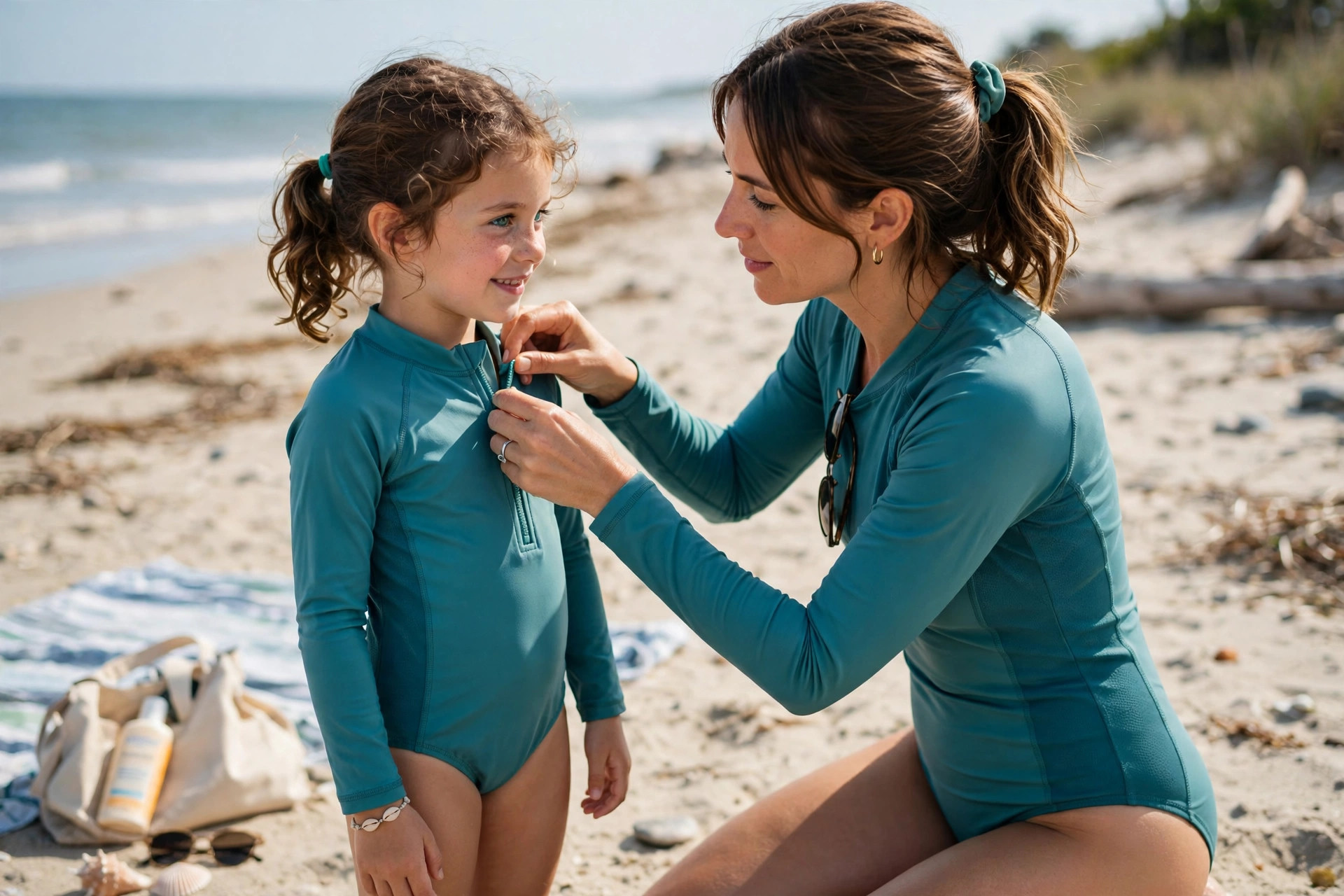
Two practical consequences follow for matching sets. First, a long-sleeve rash guard version of the family print is not a style compromise, it is the highest-protection version of the set, and for a fair or young daughter it is often the right default for midday swimming. Second, protection drops when fabric stretches or gets wet, a point both the Foundation’s clothing guide and the AAD guidance make, so a suit pulled tight across the shoulders protects less than its label promises. Size for a smooth fit, not a stretched one. The wider sun plan matters too: the EPA’s SunWise sun safety guidance and the FDA’s tips to stay safe in the sun both pair clothing with shade, hats, sunglasses, and timing around peak sun, and the World Health Organization’s ultraviolet radiation Q and A explains why children’s skin deserves the cautious end of every one of those choices. Our festival packing checklist uses the same shade, hat, and sunscreen layering for long days outdoors on land.
Matching Without Identical Suits
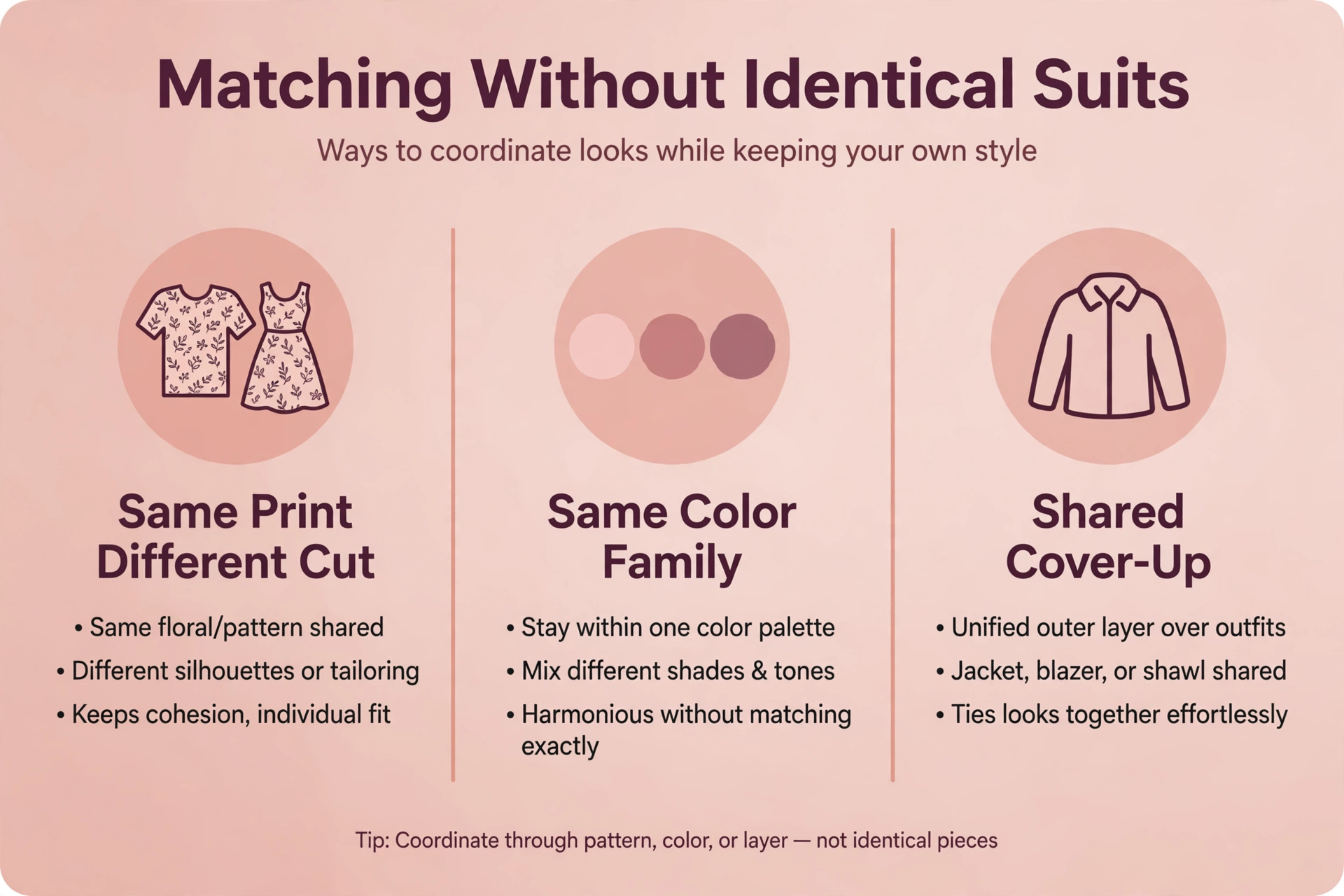
Identical suits are the listing photo, not the goal. The goal is two people who clearly belong together in the picture and are each comfortable in the water, and there are four reliable ways to get there. Same print, different cut is the first and strongest. Same color family, different prints, a floral for her and a stripe in the same palette for you, is the second, and it is the easiest to shop across different brands. A solid and a print that share one color is the third, useful when one wearer’s size is sold out in the print. Shared resort layers, cover-ups, hats, and sandals in one theme over unrelated suits, is the fourth, and it rescues matching on trips where the suits were bought separately. The wardrobe logic is the same as our matching wardrobe on a budget guide: spend on the signal that photographs, which is color and print family, and save on exact duplication nobody can see in the water.
When identical is worth it
There is one case for truly identical: the planned photo, a resort session or a first-vacation portrait, where the identical set is bought as the photo tier and worn for that morning, while the everyday swimming happens in the coordinated sets described above. That two-tier approach mirrors how our holiday matching outfits guide separates the portrait outfit from the outfit that has to survive the whole day. Buy identical for the portrait if your daughter is enthusiastic, buy coordinated for the swimming either way, and do not let the portrait set’s compromises, thin straps, novelty cuts, become the suits she actually swims in all week.
Three Sets That Get It Right
The IFFEI one-piece set below is the portrait-friendly option: a modest one-piece silhouette in a classic solid that photographs as unmistakably matching while giving both wearers real coverage. Buy it as the coordinated photo set, size each half by its own chart, and let the rash guard below do the long midday swims.

The IFFEI two-piece tank set below is the practical swimmer of the three: a tank top and high-rise bottom that give a mother real coverage and movement, with the matching family print carrying the theme. Two-piece construction also makes bathroom breaks faster, which matters more over a full pool day than any print detail, the same practical test our mother daughter brunch guide applies to outfits that have to survive a whole outing, not just an arrival.

IFFEI Mommy and Me Family Matching Swimsuits Two Piece Bikini Set Swimwear Khaki Women Medium
New starting from 27.99 $
The YOLIPULI long-sleeve rash guard below is the sun-protection tier: a zip-front one-piece with long sleeves and a stated UPF 50 rating, ordered separately in women’s and girls’ sizes in the same print. This is the set for beach days, surf lessons, and daughters who burn fast, and it pairs naturally with the destinations in our Europe trips guide where a full beach day is the plan rather than the backdrop.

Resort Wear, the Other Half of the Outfit
A vacation outfit is the suit plus everything worn around it, and the around-it half is where most packing lists fail. The cover-up has three jobs: it makes the walk through the lobby appropriate, it protects shoulders and backs during the poolside lunch when sunscreen has worn thin, and it dries fast enough to be worn again after the swim. A shirt dress or a sarong in the family print does all three and strengthens the matching in every non-swimming photo of the trip. Sandals need to survive water and grip wet tile, which rules out most fashion sandals; a simple waterproof slide in a coordinating color is the resort workhorse for both wearers. Hats follow the protection rules from the sun section: a wide brim shades face, ears, and neck, and a tightly woven hat protects better than a loose straw weave, a point the Skin Cancer Foundation’s clothing guide makes in its hat section as well.
Packing the set as a system
Pack each wearer’s swim system together: suit, second suit, cover-up, hat, sandals, and a wet bag, so a missing piece is obvious before the trip rather than at the pool. Two suits per wearer is the minimum for a multi-day trip, because a suit rinsed at night is rarely dry by morning in a humid resort room, and putting on a damp suit is the fastest way to make a daughter hate the matching plan. The second suit can be the coordinating solid rather than a second print set, which keeps cost down in the spirit of our boutique finds guide: one statement set, one smart supporting set. Add one evening layer that works over the cover-up for the walk to dinner, and the swim wardrobe covers the whole resort day without a separate outfit for every hour, a simplification our fashion trends guide keeps returning to for travel dressing generally.

Sizing, Fit Checks, and Bathroom Breaks
Swim sizing punishes guessing more than any other matching category, because a suit is worn wet, stretched, and in motion. Measure both wearers and use each brand’s own chart, because adult swim sizes and kids’ swim sizes are built on different systems, and a daughter’s size tracks her height and torso length more than her age. Torso length is the hidden variable in one-pieces: a suit that is right in the bust and hip can still pull at the shoulders if the torso is short, which is why the dry fit check matters. Put the suit on dry, raise both arms, bend, sit, and climb an imaginary set of pool steps. Straps that slip dry will not stay wet, and a bottom that rides dry will need constant fixing in the water.
The bathroom-break test
For a young daughter, the most important fit feature is not in the size chart at all. It is whether she can get the suit down and back up, wet, by herself, in a poolside restroom, quickly. One-pieces with no give and complicated backs fail this test, and the failure is miserable for everyone. Tankinis and two-pieces pass it easily, and one-pieces with a simple pull-on construction and good stretch pass it with practice at home before the trip. Practice is the operative word: the first wear should be a home trial, not the first morning of the vacation, so any lining itch, strap slip, or bathroom difficulty is discovered while returns are still possible. For mothers, the equivalent test is support in motion: jog in place, reach, and bend in the dry suit, and reject any top that needs resetting after that short sequence, because the water will ask far more of it.
Water Safety Shapes the Wardrobe
Wardrobe choices and water safety meet in a few concrete places, and a matching-outfits guide should name them rather than pretend swimwear is only about looks. The American Red Cross water safety guidance asks families to use layers of protection, including barriers, life jackets, and close supervision, and to make sure every family member learns to swim. Its swimming classes page is the practical next step for lessons for children and adults. The CDC’s drowning prevention guidance adds the supervision rule that shapes resort days: designate a responsible adult to watch closely and constantly, avoiding distractions, even when lifeguards are present, and use life jackets for children in and around natural water rather than relying on air-filled toys, which are not safety devices.
The American Academy of Pediatrics’ parent site makes the lesson point for the youngest swimmers in its swim lessons guidance: formal lessons are one layer, never a substitute for supervision. What does this mean for the wardrobe? Three things. Bright, high-contrast suit colors are easier to spot in a crowded pool than pale pastels, so let visibility argue for the bolder version of the family print. Flotation belongs in a proper life jacket, not in a novelty suit with built-in floats that can shift position. And no suit, however well fitted, changes the supervision plan, which is why our first trip with your tween guide treats water rules as part of trip planning rather than an afterthought at the pool gate.
Care That Keeps Two Suits Matching
A matching set stops matching in the rinse long before it wears out. One half fades faster, one half loses its stretch, and the vacation photo in the second half of the trip shows two cousins of the same suit rather than a pair. The defense is consistent and simple: rinse both suits in fresh, cool water after every swim, together, to remove chlorine and salt before they sit; wash gently by hand with mild detergent rather than in a hot machine cycle; and dry flat or hanging in shade, never in direct sun and never in a hot dryer, because heat and ultraviolet light are the two forces that break down elastic and fade dye. The fabric behavior behind this is the same stretch-and-moisture effect the sun section described: fibers that are stretched, wet, and heated lose both protection and shape fastest.
The habits that preserve prints and stretch
Never leave suits balled up wet in a beach bag overnight, which is where mildew smell and elastic damage start. Alternate the two sets in rotation so each rests a full day between swims, because elastic recovers its snap with rest the way it never does under daily use. Keep sunscreen application a few minutes before the suit goes on where possible, since some sunscreen ingredients stain light fabrics, and rinse suits that pick up lotion in the same evening rinse rather than letting it set. Treat the portrait set to the full ceremony and the everyday sets to at least the rinse-and-shade basics, and both tiers will still match when the next trip’s photos come around. Families extending the trip wardrobe beyond the pool can carry the same care logic into the rest of the suitcase with our festival and concert outfits guide, where outdoor fabrics face the same sun and heat.
Our view
We think matching swimsuits are where good intentions meet physics, and physics wins unless the suits are chosen for the water first. Match on the print and the color family, let each of you take the cut and the coverage that suit your body, put the long-sleeve UPF version in the bag for the long beach day, and rinse both suits together like a pair. Do that, and the matching survives the slides, the salt, and the second half of the trip, which is when the best photos actually happen. — Mother Daughter Outfits
FAQ
Do our swimsuits have to be identical to count as matching?
No. Same print in different cuts, or different prints in one color family, reads as matching in every photograph while letting each wearer take the support, straps, and coverage she needs. Identical suits are best reserved for a planned portrait, with coordinated sets doing the actual swimming.
What UPF should we look for in a matching swimsuit?
Look for a stated UPF rating on the label. According to the sun protective clothing guide, UPF 30 to 49 is very good and UPF 50 and above is excellent. Remember that the rating covers only the skin under the fabric, so pair it with sunscreen on uncovered skin, following the sunscreen FAQs.
How many swimsuits should each of us pack for a vacation?
Two per wearer. One to wear and one drying, in rotation, so nobody starts the day in a damp suit. Make the second set a coordinating solid if budget matters, and pack each wearer’s suit, cover-up, hat, and sandals together as one system.
What color swimsuit is safest for a child in a pool?
Choose the brighter, higher-contrast version of your family print. Bright colors are easier to spot in crowded, moving water, which supports, but never replaces, the close and constant supervision in the drowning prevention guidance. Pale pastels are the hardest colors to track in a busy pool.
Planning a Trip or a Matching Look?
Start with the guides other moms and daughters actually use — the Texas trips hub, the Europe breaks, and the matching-outfit guides for every age.
Sources
- What to Wear to Protect Your Skin From the Sun — American Academy of Dermatology
- Sunscreen FAQs — American Academy of Dermatology
- Guidelines for Keeping Your Pool Safe and Healthy — Centers for Disease Control and Prevention
- Preventing Drowning — Centers for Disease Control and Prevention
- Sun Protective Clothing — The Skin Cancer Foundation
- Expert Answers to Your Sun Protection Questions — The Skin Cancer Foundation
- Sunscreen — The Skin Cancer Foundation
- Water Safety — American Red Cross
- Swimming Classes — American Red Cross
- Swim Lessons — HealthyChildren.org, American Academy of Pediatrics
- SunWise and Sun Safety — U.S. Environmental Protection Agency
- Tips to Stay Safe in the Sun, From Sunscreen to Sunglasses — U.S. Food and Drug Administration
- Ultraviolet Radiation, Questions and Answers — World Health Organization