As an Amazon Associate I earn from qualifying purchases.
You found the perfect matching set, held it up with real excitement, and watched your teenage daughter veto it in under three seconds. That veto is not the end of matching with a teen. It is the starting condition. Teenagers are building an identity that is visibly separate from yours, and clothing is one of the first places that work happens in public. This guide starts from her buy-in, then builds three levels of coordination she can choose from, so the two of you still get the shared look, the photo, and the afternoon, without a fight in the doorway.
Mother Daughter Outfits
Matching She Actually Agrees To
Start with the casual weekend looks teens wear without negotiating, then build up to full matching on her terms.
Key Takeaways
- Her veto is developmental, not personal, so treat buy-in as the first step of the outfit, not an obstacle before it.
- Offer three levels, full matching, shared pieces, and palette only, and let her pick the level for each occasion.
- Shared pieces win most often with teens, because one agreed item carries the matching while the rest stays hers.
- School events and weekends follow different rules, so plan the look around where her friends will see it.
- Size her half from women’s or junior charts by her measurements, because teen bodies no longer follow kids’ sizing.
Table of Contents
- Why She Says No, and Why That Is Healthy
- Three Levels of Matching, Ranked by Teen Buy-In
- The Shortlist Method, How She Chooses Without a Fight
- Sizing a Teen, Between Kids Charts and Women’s Charts
- School Events, Where the Audience Is Her Friends
- Weekends, Trips, and the Looks She Asks For
- Three Picks That Pass the Teen Test
- Photos, Posting, and Her Permission
- When She Still Says No to Everything
- Our view
- FAQ
Why She Says No, and Why That Is Healthy
Start with the developmental fact, because it changes how the whole conversation feels. The American Academy of Pediatrics describes adolescence as a period defined by a gradual move toward autonomy, in which a young person builds individual decision making step by step. Clothing sits right on that path. A matching outfit chosen entirely by her mother can feel, to a fourteen-year-old, like being dressed as a child in front of the exact audience she is trying to impress. Her no is often about the choosing, not the clothes.
The federal adolescent health guidance on emotional development in adolescence explains that teenagers become more aware of their own feelings and of how others see them, while the reasoning systems that steady those feelings are still maturing. That combination makes a public outfit feel high stakes. The MedlinePlus overview of adolescent development milestones puts the same point plainly: it is normal for young people in these years to separate from their parents and form their own identity, and friends become more important as that happens. A veto at the closet door is that separation, happening over a dress.
None of this means the matching idea is over. The Pew Research work on young adults and their parents finds that most young people describe strong relationships with their parents and say they can be themselves around them. The connection survives the teen years when it is renegotiated rather than defended. Matching works the same way. The mothers who keep matching through the teen years are the ones who move from dressing a daughter to dressing with one, which is exactly the shift our casual weekend style guide is built on for ordinary Saturdays.
The audience problem
A younger daughter dresses for the family photo. A teen dresses for her friends, her classmates, and the version of herself she is testing that month. The HHS material on social development in adolescence notes that building connections and identities outside the family is a normal part of healthy development, and that peers shape how adolescents present themselves. The LibreTexts chapter on social development and identity describes the same renegotiation inside the family, as parent and teen rebuild their relationship on more equal terms. Read those two together and the shopping rule writes itself: any look she will wear where peers can see it has to survive her audience test first, and she is the only judge on that panel.
That is also why the adult-daughter posts on this site do not solve this problem. The dynamic in our piece on how adult daughters influence moms’ style runs in the other direction, from a grown daughter with settled taste. A teen is mid-construction. Her taste changes by semester, and the outfit has to leave room for that, the way the planning in our first trip with a tween guide leaves room for her say in the itinerary.
Three Levels of Matching, Ranked by Teen Buy-In
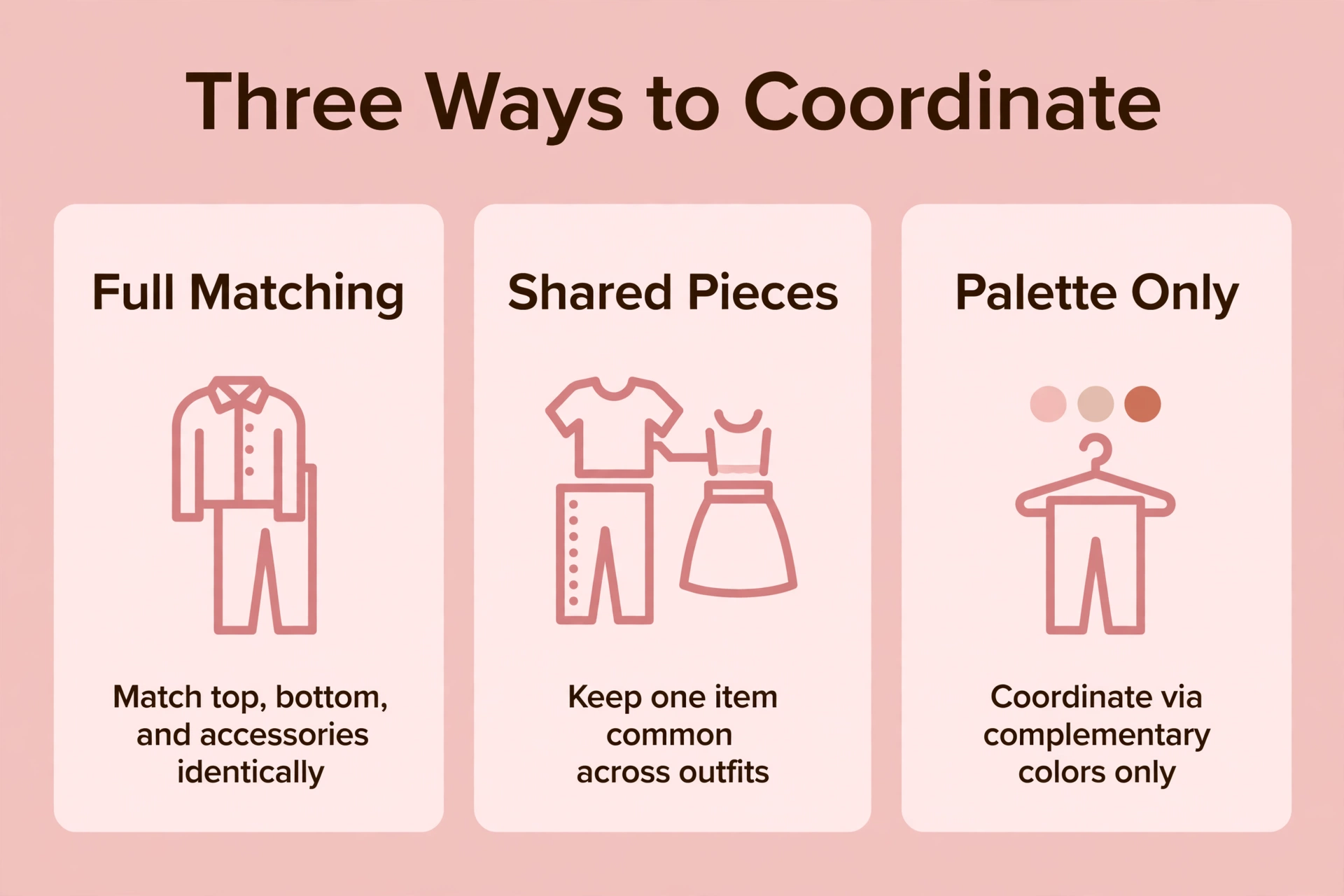
The practical fix is to stop treating matching as one thing. It is three different offers, with three different buy-in prices, and she gets to choose which one an occasion gets. Full matching, identical or near-identical outfits, is the highest price: it works for photos, holidays, and the teens who genuinely love it, and it fails everywhere her friends are watching. Shared pieces, one agreed item in common, is the middle offer and the teen workhorse: the same jacket, tee, or accessory, styled her way underneath. Palette only, different outfits in one color family, is the lowest price and the easiest yes, because nothing about it announces itself as matching until the photo puts you side by side.
The comparison below lays the three levels side by side, so you can see what each one costs her and what it buys you.
| Level | What it looks like | Teen buy-in needed | Best occasions |
|---|---|---|---|
| Full matching | Same dress, set, or print on both of you | High, reserve it for when she suggests or loves it | Family photos, holidays, matching pajama mornings |
| Shared pieces | One item in common, styled differently by each of you | Medium, the everyday default for teens | School events, concerts, weekend outings |
| Palette only | Different outfits built from one color family | Low, almost always an easy yes | Brunch, trips, any day her friends are along |
Notice that the lower levels are not failed matching. Palette-only coordination is the same principle the grown-up end of this site uses, and it photographs as intentional rather than identical. Our photo shoot outfits guide builds whole sessions on palette coordination for exactly this reason: the camera reads color families as a set, even when no two garments match. With a teen, that camera logic is your ally. She keeps her own outfit, you keep the photograph.
Start at the level she already lives at
Most teens already own the shared piece without knowing it. Denim jackets, white sneakers, a favorite band or graphic tee style, and plain hoodies live in both closets at once. Our roundup of graphic tee styles both generations love is full of that overlap, and it is the cheapest place to begin, because the first shared look costs nothing and proves the concept before any money moves. The guidance for educators and parents on teenage fashion and self-expression makes the underlying point: fashion works for teenagers as creative expression, and confidence grows when the choice feels like theirs. A shared piece she already chose for herself is expression first and matching second, which is the correct order.
The Shortlist Method, How She Chooses Without a Fight
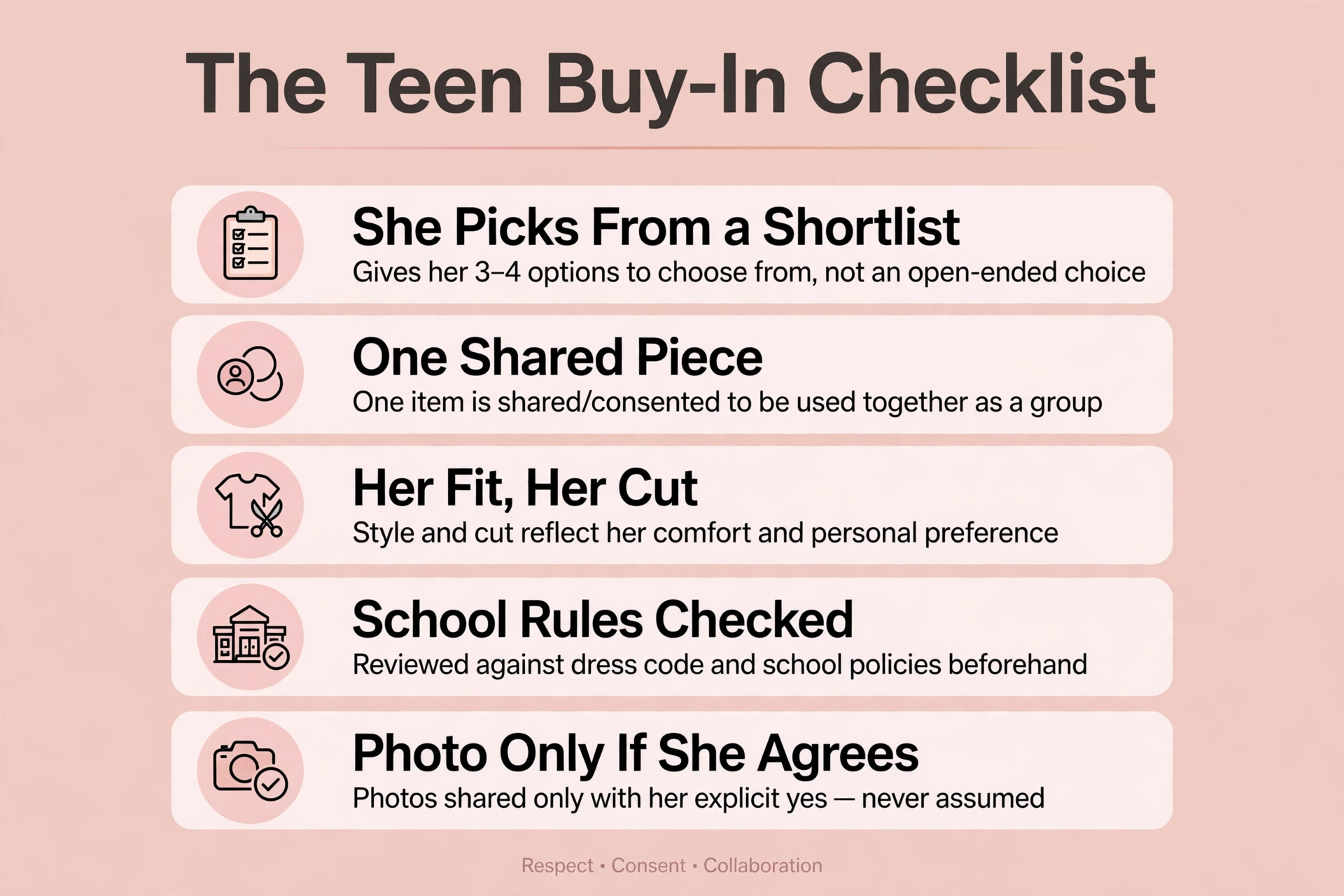
The method that replaces the doorway fight has three steps. First, you do the invisible work alone: pick three or four options that fit the occasion, the budget, and the level you are hoping for. Second, she chooses from that shortlist, with a real veto over any single item and the right to pick the level down one step. Third, whatever she picks is final, with no commentary at the mirror. The structure matters because it gives her the two things the developmental research keeps pointing at: genuine choice, and a boundary she did not have to fight for.
The CDC guidance on parental monitoring and communication frames the parent side of this well: clear expectations, regular check-ins, and talking and listening often are what keep influence alive through the teen years. A shortlist is that pattern in miniature. You set the frame, she makes the call inside it, and the conversation stays open for the next occasion. The University of Delaware extension guide to understanding teenagers adds that conflict in these years is common and normal, and that understanding the changes underneath it helps parents respond rather than escalate. An outfit argument is rarely about the outfit. Treating it as a negotiation about autonomy, with a method attached, ends most of them.
Rules that keep the method working
Keep the shortlist short. Four options is a choice, fourteen is homework, and homework gets vetoed wholesale. Shop at her speed, which usually means links sent to her phone and answered later, not a mall marathon. Let her style her half without edits, including the shoes you would not have chosen. And bank the wins quietly: a shared-pieces yes this month is what makes a full-matching photo possible later, the same slow build our matching wardrobe on a budget guide recommends for the closet itself. Spend the patience first, and the wardrobe follows.
The sleep side of the wardrobe runs on the same method, by the way. Our guide to matching mother daughter pajamas has a whole section on the teen end of the pajama drawer, where the identical set gives way to same-family prints in her cut and yours. Pajamas are often the first full-matching yes a teen gives, because the audience is the couch, not the school hallway.
Sizing a Teen, Between Kids Charts and Women’s Charts
Teen sizing is where good intentions go to be returned. She has outgrown the kids chart, where sizes run by age and height, but women’s sizing assumes curves and proportions she may not have yet, and junior sizing, where it exists, runs smaller and shorter than women’s in the same number. The only reliable route is measurements: bust, waist, and hip for dresses, inseam for pants, compared against the specific brand’s chart for the specific half she will wear. Order her half by the chart, not by the size she wore last season, because growth in these years is measured in months.
The University of Washington guide to the growing teenager describes these as years of growth spurts and rapid physical change, with each child progressing at a different rate. That is the sizing problem stated medically. Two thirteen-year-olds can be four sizes apart, and the same girl can cross two sizes between the school play and summer. Build the return window into every teen purchase, keep tags on until the try-on, and never buy a non-returnable full-matching set for a teen you have not measured this season.
Her fit, her cut
Fit preference is part of buy-in, not a separate battle. Many teens will accept a shared print in an oversized cut who would refuse the same print fitted, and many prefer their half styled looser, longer, or layered. The Child Mind Institute voices piece, in which teen sisters describe self-acceptance under peer pressure, captures how intense the wish to control her own presentation can feel from the inside. Letting her choose the cut of her half costs you nothing visually, the print or palette still carries the match, and it converts the garment from your choice into hers. The trend cycle helps here too: our look at mother daughter fashion trends keeps finding oversized and relaxed silhouettes cycling back, which means her preferred cut is usually the fashionable one anyway.
School Events, Where the Audience Is Her Friends
School events are the hardest venue and the most common one: concerts, plays, award nights, games where she is performing, volunteering, or simply visible. The rule for school ground is shared pieces or palette only, never full matching, unless she asks. She has to walk back into that building on Monday among people who saw the outfit, and the social math of that is hers to run. The HHS social development material notes that adolescents may change how they dress to gain peer approval, which is not vanity. It is the social curriculum of the age, and an outfit that ignores it taxes her for your photograph.
What works at school events is the quiet shared piece. Matching denim jackets over different outfits. The same sneakers. A shared color that reads as coincidence. These carry a private signal between the two of you, which many teens genuinely like, without a public announcement. If she is performing, match to her costume or team colors in palette only, from the audience, so the support shows in photos without sharing her spotlight. The louder end of shared dressing belongs elsewhere, at the festival and concert outfits where the crowd is strangers and the whole point is to be seen.
Dress codes and practical checks
Check the school dress code before her half is final, not after. Sleeve, length, and strap rules apply to students at school events even when the event is in the evening, and a forced cover-up at the door ruins the look and the night. Comfort checks matter as much: she will sit on bleachers, stand in hallways, and help move chairs, so her half has to survive movement, not just photographs. The CDC sleep guidance, which asks eight to ten hours for teenagers, is the quiet footnote to every school-night event: the outfit planning that happens calmly in advance, shortlist and all, is also what gets everyone to bed at a sane hour instead of arguing at nine in the evening.
Weekends, Trips, and the Looks She Asks For
Weekends are where teen matching actually lives, because the audience shrinks to family, a friend or two, and the camera you control. This is the natural home of the looks in our casual weekend style guide, rebuilt at teen settings: palette-only for the farmers market, shared tees for the errand run, and full matching saved for the mornings she is feeling sentimental, which arrive more often than the doorway vetoes suggest. Brunch is the easiest weekend win of all, since the venue flatters coordination and the photos are guaranteed; our mother daughter brunch guide covers the dressing, and a teen at palette level fits straight into it.
Trips raise the stakes and the opportunity at once. Away from her school audience, many teens relax about matching noticeably, which is why the planning approach in our first trip with a tween guide, her say in the plan, a pace she helped set, a budget she can see, transfers directly to older teens and to trip wardrobes. Pack by palette for the whole trip and every day coordinates without a single identical garment, then let her decide whether the one planned photo day goes full matching. The Pew findings on how teens and parents approach screen time together are a useful reminder for trip photos specifically: phones are a standing negotiation in these years, so agree the photo plan, hers included, before the trip rather than at the viewpoint.
The friend-along test
The truest test of a teen look is whether she would wear it with a friend along. If yes, it is a real outfit. If it only works when the friend cancels, it is a costume she is tolerating. Build the weekend wardrobe to pass the friend test and you will find she reaches for the shared pieces herself, which is the moment matching stops being your project. Retail therapy has a place in this too: a shared browsing trip with a small budget each, along the lines of our boutique finds guide, lets her discover the overlap in your tastes at her own pace, in public, on her terms.

Three Picks That Pass the Teen Test
The SOFEON sequin letter tee set below is the shared-pieces strategy in product form: a Mama shirt and a Mama’s Girl shirt that read as a pair in a photo and as ordinary, glittery tees everywhere else. Sold separately by size, so her half can be ordered in the cut and size she actually wants, and the sparkle does the coordinating work that an identical outfit would otherwise have to do.

The AWIBMK floral dress below is the full-matching option, kept for the occasions that earn it: a family photo, a holiday, a day she is in the mood. The ruffled lantern sleeve and long A-line cut come in separate women’s and girls’ size runs, so each half is sized from its own chart, and the print is romantic enough that teens tend to file it under dress-up rather than under twinning. For the dressed-up calendar around it, our holiday matching outfits guide covers the rest of the season.

The IFFEI square neck maxi below is the palette-and-print middle path: a ruffle A-line beach maxi in women’s and girls’ versions that coordinates beautifully for trips and weekend photos while staying loose, long, and comfortable enough for a teen to forget she is matching anyone. It is the pick most likely to be worn again on a day you are not in the photo, which is the highest compliment a teen outfit can earn.

Photos, Posting, and Her Permission
The photo is the point of matching for most mothers, and it is the risk point for most teens, so it gets its own rules. Ask before posting, every time, and let her approve the specific shot. A teen who controls her image will pose for far more photos than a teen who finds herself tagged by surprise. The research on appearance pressure collected by the healthier Michigan overview shows how quickly appearance scrutiny can slide into anxiety for teenagers, and parental posting is one of the few sources of that scrutiny a mother fully controls. Keep it controlled.
In the moment, lower the photographic stakes. Candids over poses, one or two frames over a session, and a standing rule that a no to a photo is accepted without a sigh. The formal end of family photography is a separate, agreed occasion, and our photo shoot outfits guide treats it that way, with the session planned, the palette agreed, and the photographer’s guidance followed. A teen who trusts that everyday matching will not turn into an ambush photo shoot is a teen who says yes to the real session when it is booked properly.
When She Still Says No to Everything
Some seasons, the answer is no at every level, and the correct response is to believe her and stand down gracefully. A full veto season usually tracks something else: a new school, a friendship upheaval, a body change she is adjusting to. The developmental sources agree that this is weather, not climate. The AAP’s account of adolescence as a bridge to adult decision making implies the direction of travel: autonomy now, chosen closeness later, on terms she sets. The Pew data on young adults who can be themselves around their parents suggests the closeness does come back, and the mothers who get the adult version of matching, the one in our edgy boutique looks guide, are often the ones who did not force the teen version.
Keep the door open with invitations that carry no outfit requirement: the trip, the brunch, the browsing afternoon. When she is ready, she will usually reopen the subject herself, often by stealing something from your closet, which is shared pieces arriving by the oldest route there is.
Our view
We think matching with a teen is not a smaller version of matching with a little girl. It is a different craft entirely, closer to a negotiation between equals who happen to share a closet budget. Give her the shortlist, the level choice, and the photo veto, and what you get back is better than identical dresses: a daughter who coordinates with you because she wants to, in outfits she would wear anyway, in photos she approved. The matching was never really about the clothes. It was about being chosen, at an age when she is choosing everything. — Mother Daughter Outfits
FAQ
Why does my teen refuse matching outfits she used to love?
Because the job of the teen years is building a separate identity, and clothing is public identity work. The HHS guidance on emotional development describes teenagers becoming far more aware of how others see them, and the MedlinePlus adolescent development overview treats separating from parents and forming her own identity as normal milestones. She has not rejected you. She has rejected being dressed, which the shortlist method fixes by handing her the choosing.
What level of matching do teens accept most often?
Shared pieces, by a wide margin. One agreed item, a jacket, tee, or sneakers, styled her own way, carries the coordination without announcing it. Palette-only looks are the easiest yes of all, and our casual weekend style guide is built almost entirely at that level. Save full matching for photos and holidays, and let her be the one to suggest it.
How do I size her half of a matching set?
By her current measurements against that brand’s chart, never by age and never by last season’s size. The UW guide to teen growth and development notes that teens progress through growth spurts at very different rates, so measure each season, expect her to sit between kids and women’s charts, and keep the return window open until she has tried it on.
Should I post our matching photos if she says no?
No. Her permission is part of the outfit. The CDC’s guidance on talking and listening to teens puts open communication at the center of parental influence in these years, and nothing closes communication faster than a photo she finds posted against her wishes. Ask, accept the answer, and the yeses will keep coming.
Planning a Trip or a Matching Look?
Start with the guides other moms and daughters actually use — the Texas trips hub, the Europe breaks, and the matching-outfit guides for every age.
Sources
- Unique Needs of the Adolescent — American Academy of Pediatrics
- Young Adults’ Relationship With Their Parents — Pew Research Center
- Emotional Development, Adolescent Development Explained — HHS Office of Population Affairs
- Social Development, Adolescent Development Explained — HHS Office of Population Affairs
- Parental Monitoring — Centers for Disease Control and Prevention
- About Sleep — Centers for Disease Control and Prevention
- Adolescent Development — MedlinePlus Medical Encyclopedia
- Social Development in Adolescence — LibreTexts Child Development
- Understanding Teens — University of Delaware Cooperative Extension
- Our Voices, Teen Sisters on Self-Acceptance — Child Mind Institute
- Understanding Teenage Fashion Trends — Edu.com
- The Growing Child, Teenager 13 to 18 Years — UW Medicine Health Library
- How Teens and Parents Approach Screen Time — Pew Research Center
- Why Looksmaxxing Is Bad for Teenage Mental Health — A Healthier Michigan